
Creating an “AI Researcher” That Experiments in Space — Two Patents Jointly Filed on an Autonomous Experimentation Platform Where an LLM Connects Observation, Judgment and Operation
Space Seed Holdings Inc. (Headquarters: Minato-ku, Tokyo; CEO: Kengo Suzuki, “the Company”) announces that, jointly with its subsidiary Regenesome Inc., IDDK Co., Ltd., and Spacenome Lab., Inc., it filed two patent applications on June 10, 2026, concerning apparatus and control technologies that use machine learning models—including LLMs (Large Language Models)—to autonomously advance cell culture and a variety of scientific experiments.
The two applications filed are “Integrated Autonomous Experimentation Apparatus for Cell Experiments and Control Method Therefor” (Japanese Patent Application No. 2026-097387) and “Integrated Experiment Module Control Apparatus and Control Method Therefor” (Japanese Patent Application No. 2026-097380). Both are joint applications by the Company, Regenesome Inc., IDDK Co., Ltd., and Spacenome Lab., Inc.
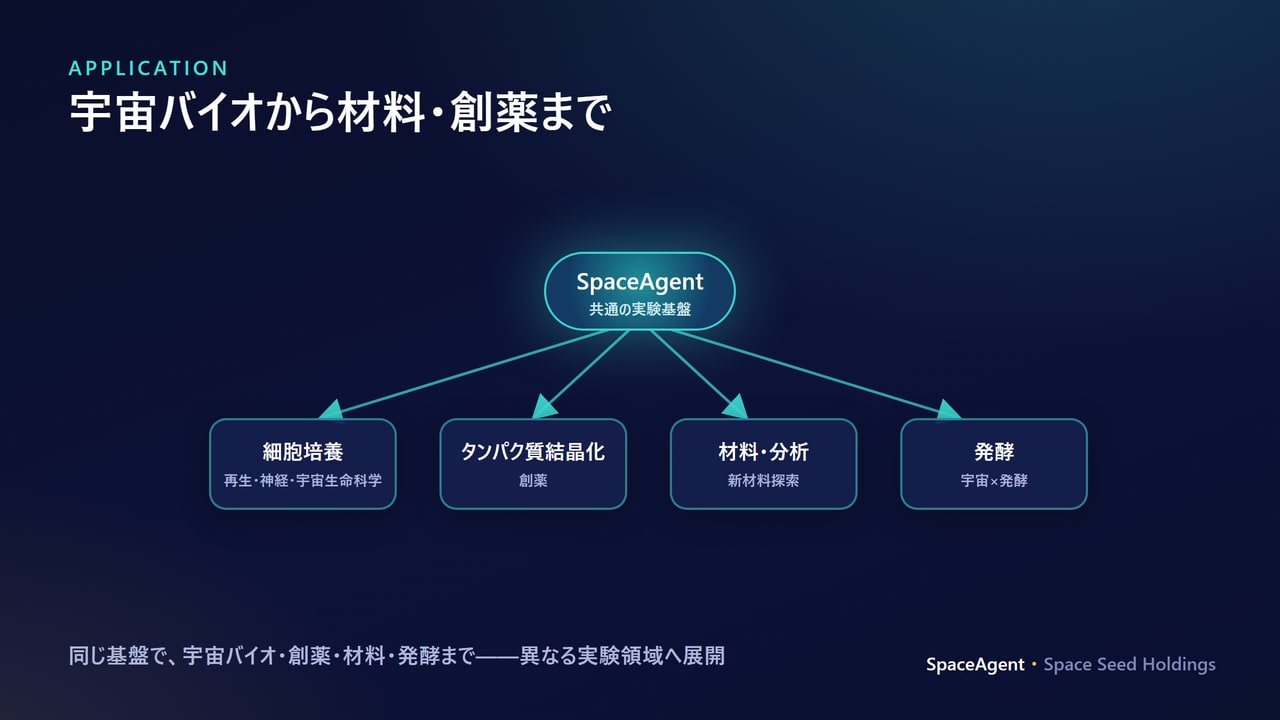
These two applications are positioned as a first step toward a common platform that, beyond a single cell-culture device, autonomously designs, executes, and analyzes experiments across different scientific fields—microalgae and microbes, cells and organoids, drug-discovery screening, regenerative medicine, and materials synthesis.
Background: How to Run Experiments in Space, Where Researchers Cannot Stand Beside the Equipment
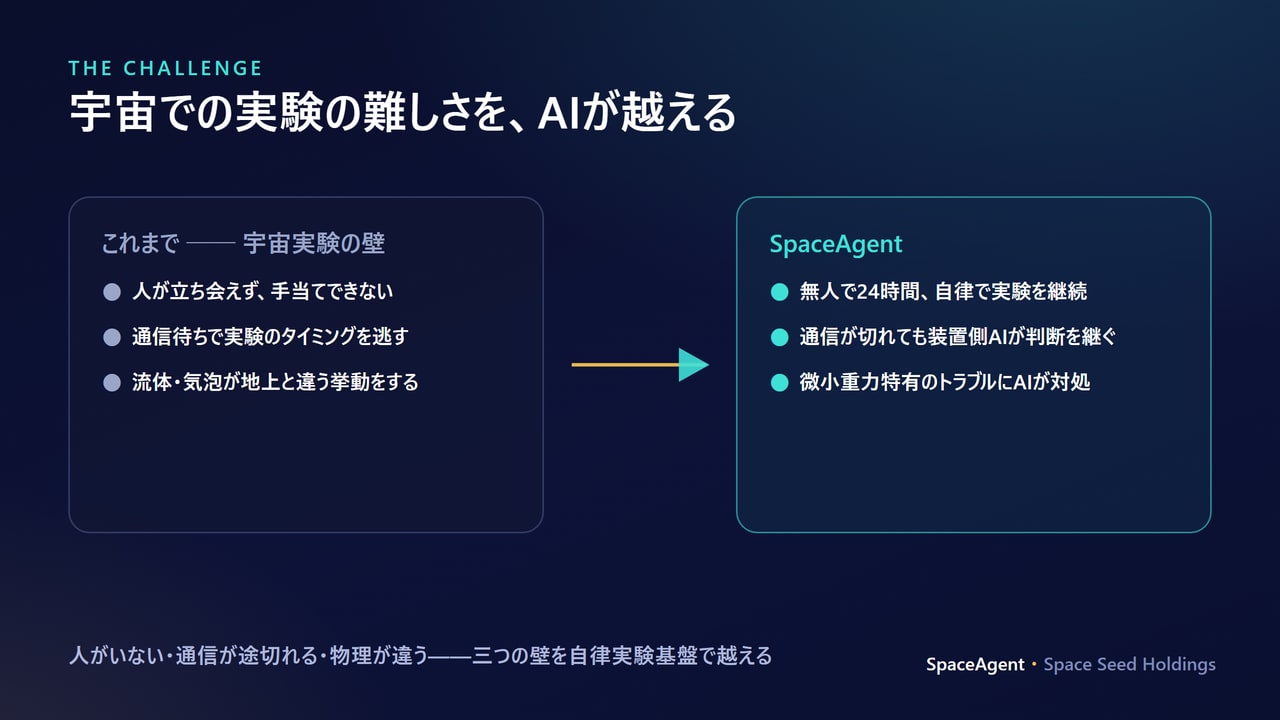
In space (in orbit and on the Moon), researchers cannot stand beside the equipment. Power, volume, and communication bandwidth are limited, and communications are subject to delay and interruption. The acts that people have carried out—observing, interpreting, and deciding the next operation—must therefore be built into the equipment itself. What we aim for is an “autonomous laboratory.”
Around the world, research on the “Self-Driving Laboratory,” which automatically advances everything from experiment planning to equipment operation, is progressing. Known examples include Coscientist in chemistry, which uses an LLM at its core to handle literature search, planning, and equipment operation, and A-Lab, which autonomously explores the synthesis of new inorganic materials in a closed loop. To extend these concepts to space, where communications, power, and volume are limited, it is not enough to automate a specific experiment; a mechanism is needed to coordinate multiple instruments through a common control layer. The two applications filed this time consist of two mutually complementary layers: “autonomous control specialized for cell experiments” and “higher-level integrated control that reconfigures equipment across fields.”
Filed Technology 1: Integrated Autonomous Experimentation Apparatus for Cell Experiments (Application No. 2026-097387)
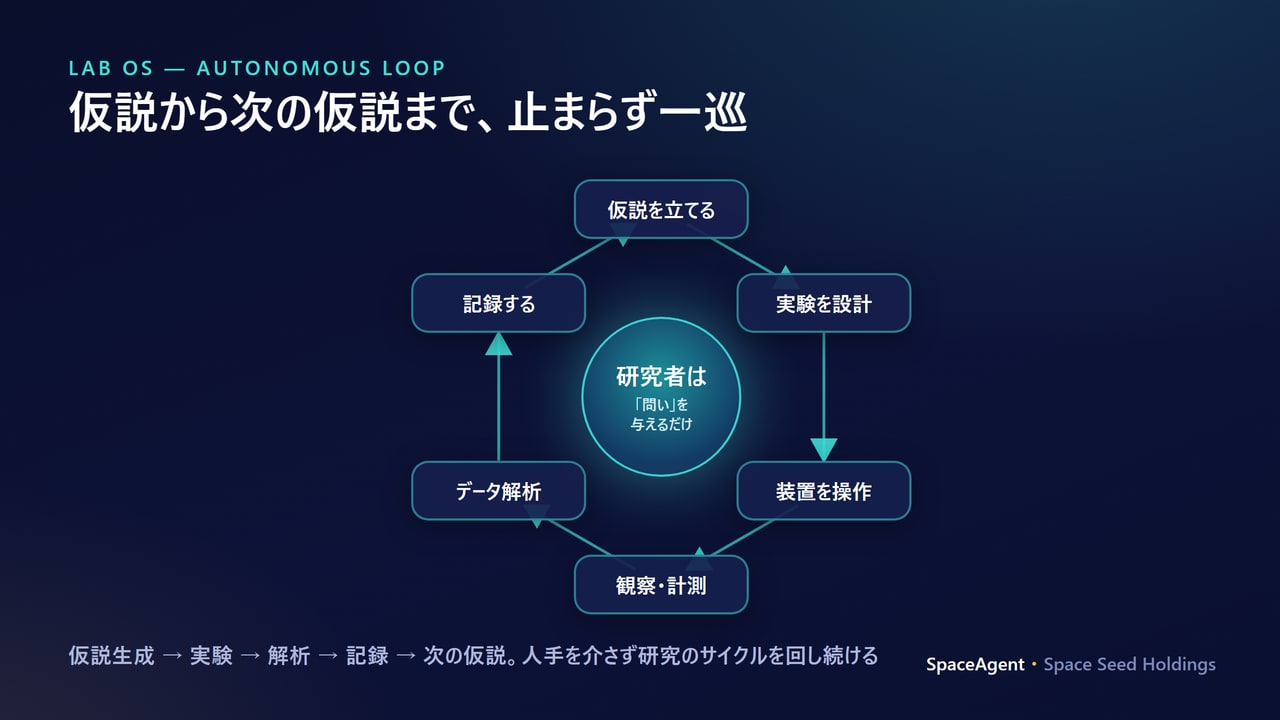
This technology integrates, as a single unit, a culture vessel, a microscopic observation section, a delivery mechanism (culture medium, reagents, bioactive substances), and an environmental control section (temperature, pH, dissolved oxygen, CO₂, light). It inputs heterogeneous data—microscope images, sensor values, and delivery history—into a machine learning model as a common context, and continuously decides multiple operations: substance delivery and environmental adjustment.
Rather than replaying a predetermined schedule, it changes the next operation according to the observed state of the cells. It switches the liquid-handling method between 1 G and microgravity environments, and it also covers recovery actions—such as reducing the dispensing rate, temporarily halting discharge, and purging—when bubble intrusion is detected by images or sensors.
Filed Technology 2: Integrated Experiment Module Control Apparatus (Application No. 2026-097380)
This technology is a higher-level control platform not limited to cell experiments. It connects experiment modules with different functions—observation, liquid handling, culture, environmental control, analysis, materials synthesis, property evaluation, and more—through a common interface, and an LLM interprets images, numerical values, spectra, and operation logs across modules to distribute execution commands to each module. By swapping modules, the same platform can be reconfigured for different purposes.
As long as a module conforms to the common protocol, even a module developed by a third party can be added without large-scale customization, because the LLM reads its specifications. The platform also features edge-cloud coordination that switches the subject of inference: a high-performance model in the cloud when communications are good, and a local model on the equipment side when delay or interruption is predicted. The concept is less a control software that drives individual devices than something close to an “operating system for scientific experiments.”
Background of the Four Companies
Spacenome Lab., Inc. is advancing a plan to observe euglena under microgravity using IDDK’s lensless microscopic observation aboard the recovery satellite “Aoba” (scheduled for launch from the latter half of 2026 onward). IDDK Co., Ltd. and Regenesome Inc. concluded an MOU in December 2024 on the joint development of an exosome production device for space experiments. Regenesome Inc. holds technologies for improving the productivity of nanoparticles such as exosomes and of viral vectors, and in March 2026 it jointly filed, with Good Hero Therapeutics and euglena Co., Ltd., a technology for enhancing viral-vector productivity using ergothioneine. In the materials field, the Company will connect its alloy Materials Informatics search system and its joint research on ultra-high-pressure SPS with Professor Yoshihisa Mori of Okayama University of Science into an autonomous materials-exploration loop.
Anticipated Applications
・Exploration of culture conditions for microalgae, yeast, and bacteria
・Optimization of culture and differentiation conditions for cells, stem cells, and organoids
・Screening of drug candidates, culture media, and bioactive substances
・Optimization of production conditions for exosomes and viral vectors
・Synthesis and evaluation of materials such as alloys, ceramics, and semiconductors
・Experiments in extreme environments such as microgravity, radiation, and hypoxia
・Comparative studies using common equipment and protocols on the ground and in orbit
Outlook
The Company will first advance verification of equipment integration and closed-loop control on the ground, then proceed in stages to simulated-microgravity testing using clinostats and to local-inference testing under communication constraints. On that basis, it will consider, step by step, implementation in the ultra-compact space experiment module “SpaceAgent.” In parallel, the Company will promote joint research with universities, research institutions, and companies that hold related technologies. Through its space-utilization research business, the Company will provide integrated support spanning the design of research themes, ground-based simulation, ultra-compact module development, in-orbit experiments, data analysis, and the acquisition and use of intellectual property.
Comment from the CEO
In laboratories on the ground, researchers look at microscope images, judge the state of cells and microbes, and finely adjust culture media, reagents, temperature, and gas conditions. In space, however, researchers cannot stand beside the equipment. The back-and-forth of observation, interpretation, and operation that people have carried out on the ground must be transplanted into the equipment. These applications were designed to use the LLM not merely for conversation, but as a “control layer for research” that reads experimental data, considers the next operation, and records the reasons for it. We regard microbes, cells, drug discovery, regenerative medicine, and materials science not as separate research fields, but as subjects of a common research loop that repeats observation and hypothesis testing. We will create a future in which research equipment nurtured on the ground can continue research as-is in orbit and on the Moon, transforming space into a new experimental field for humankind.
—Kengo Suzuki, Representative Director and CEO, Space Seed Holdings Inc.
Overview of the Patent Applications
・Japanese Patent Application No. 2026-097387, “Integrated Autonomous Experimentation Apparatus for Cell Experiments and Control Method Therefor” (filing date: June 10, 2026)
・Japanese Patent Application No. 2026-097380, “Integrated Experiment Module Control Apparatus and Control Method Therefor” (filing date: June 10, 2026)
Applicants: Regenesome Inc., Space Seed Holdings Inc., IDDK Co., Ltd., and Spacenome Lab., Inc.
*This announcement concerns the filing of patent applications and does not indicate that any patent right has been established or registered at this time.
About Space Seed Holdings Inc.
Space Seed Holdings Inc. is a space-focused deep-tech venture builder with the mission of “Turning Science Fiction into Nonfiction.” The company engages in investment, research, and venture creation, centered on operating the “Fermentation and Longevity Fund,” which supports the social implementation of fermentation and longevity technologies to address societal challenges. In collaboration with diverse stakeholders, Space Seed Holdings aims by 2040 to assemble the technologies necessary for sustained human habitation in space.
https://ss-hd.co.jp