
Copper and Diamond Sintered at 700 °C in Five Minutes: Preliminary Study Using a Retrofittable “Clamp-Type Ultra-High-Pressure SPS” Presented at the JSAP Autumn Meeting
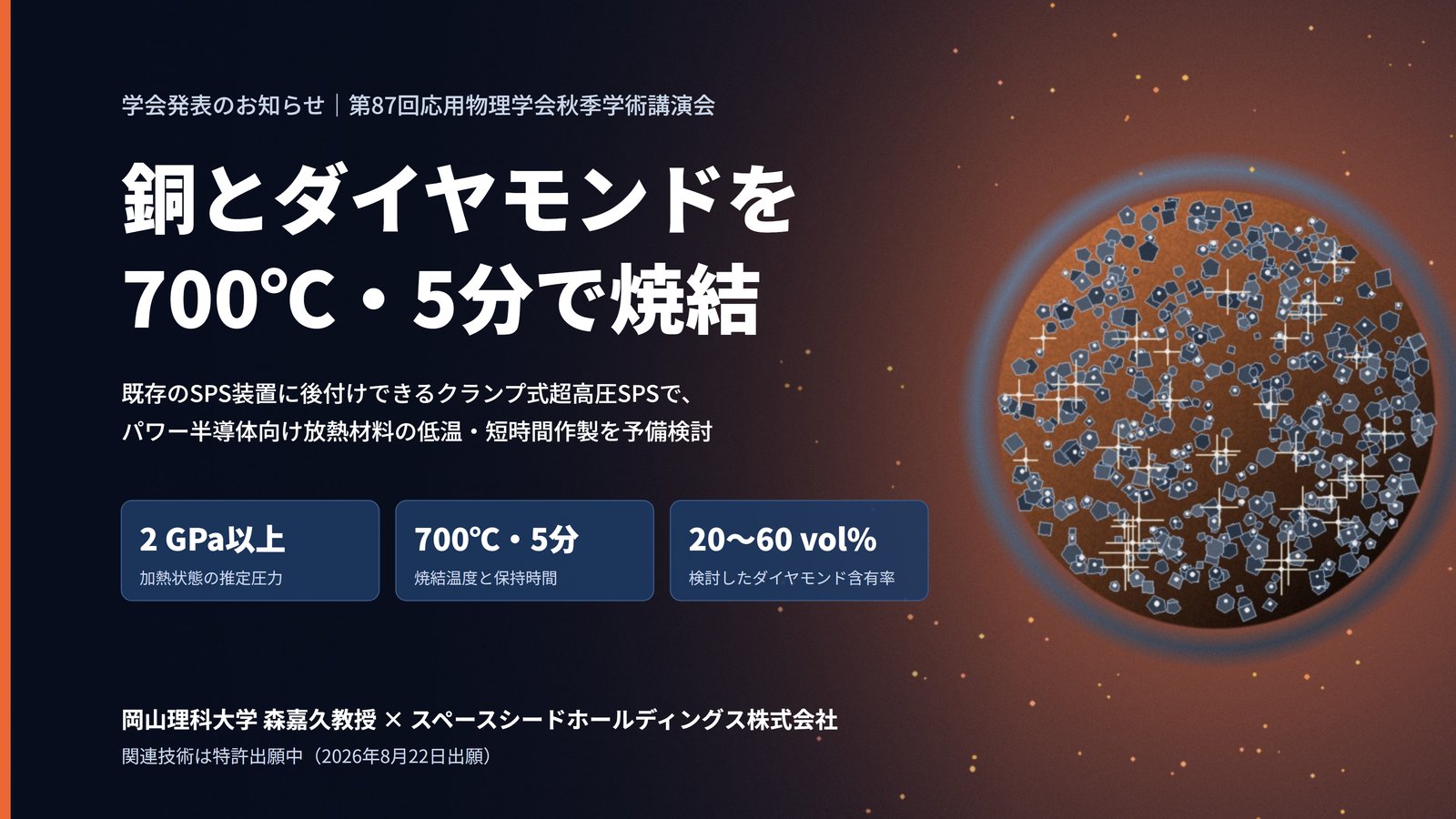
Space Seed Holdings Inc. (Headquarters: Minato-ku, Tokyo; Representative Director and CEO: Kengo Suzuki; “the Company”) announces that results of its joint research with Professor Yoshihisa Mori of the Faculty of Science, Okayama University of Science, were presented at the 87th JSAP (Japan Society of Applied Physics) Autumn Meeting (September 8–11, 2026, Sapporo Campus of Hokkaido University and online).

- Conference: The 87th JSAP Autumn Meeting
- Dates and venue: September 8–11, 2026; Sapporo Campus, Hokkaido University, and online
- Title: Preliminary study on fabricating high-diamond-content Cu composites using ultra-high-pressure SPS
- Presenters: Yoshihisa Mori (Faculty of Science, Okayama University of Science; speaker); Kengo Suzuki (Space Seed Holdings Inc.)
Highlights
- Copper and diamond sintered at 700 °C in five minutes under GPa-class pressure. Under an estimated pressure of 2 GPa or more (about 20,000 atmospheres or more) in the heated state, a sintering temperature of 700 °C and a five-minute hold, samples containing 20–40 vol% diamond were recovered with their shape intact.
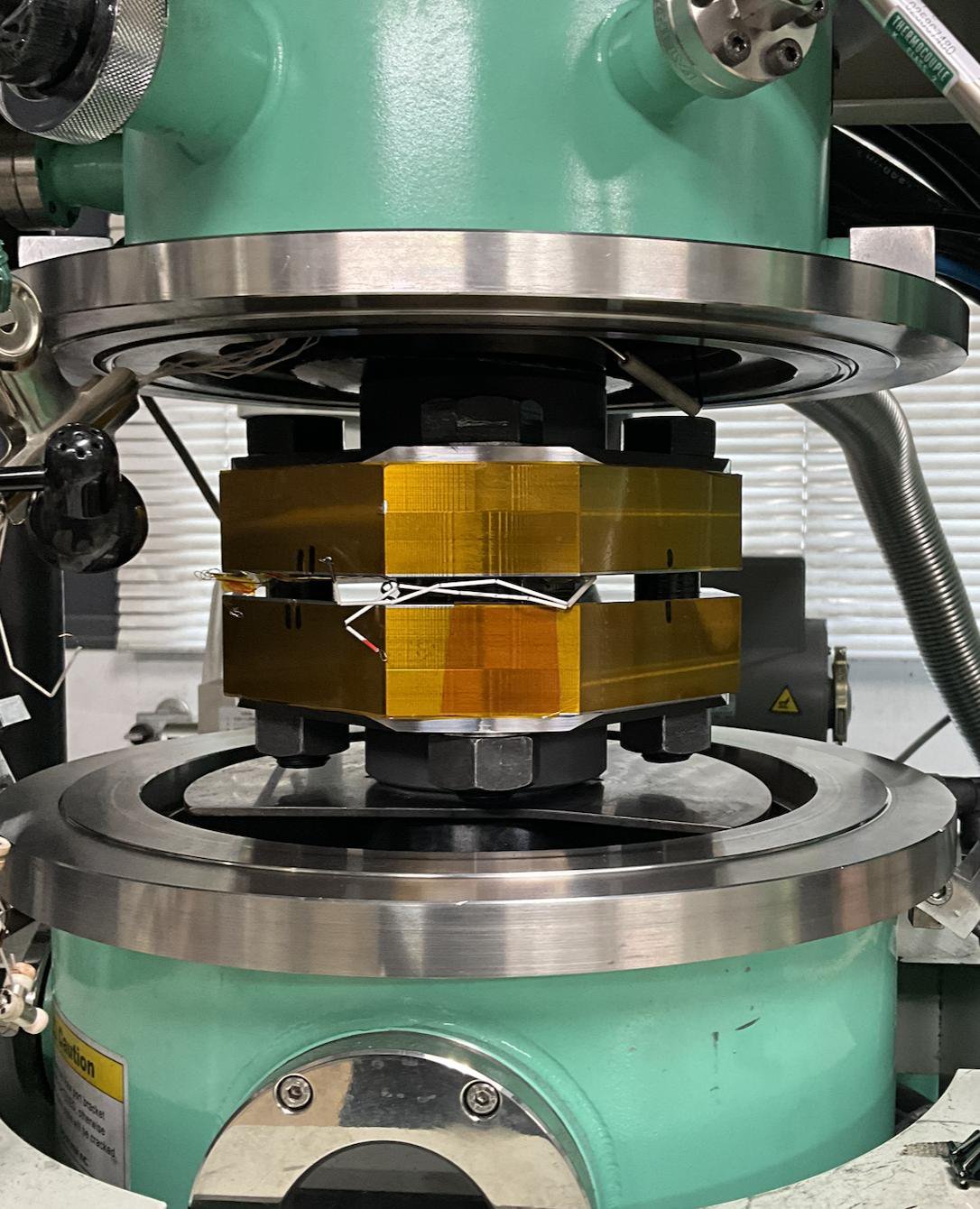
- Equipment that can be retrofitted to an existing SPS machine. Instead of large high-pressure facilities, the experiments used a clamp-type ultra-high-pressure SPS unit attached to an existing spark plasma sintering (SPS) machine.
- A preliminary study. Evaluation was by visual inspection. The effectiveness of the method will be verified through microstructural observation and thermal-property evaluation.
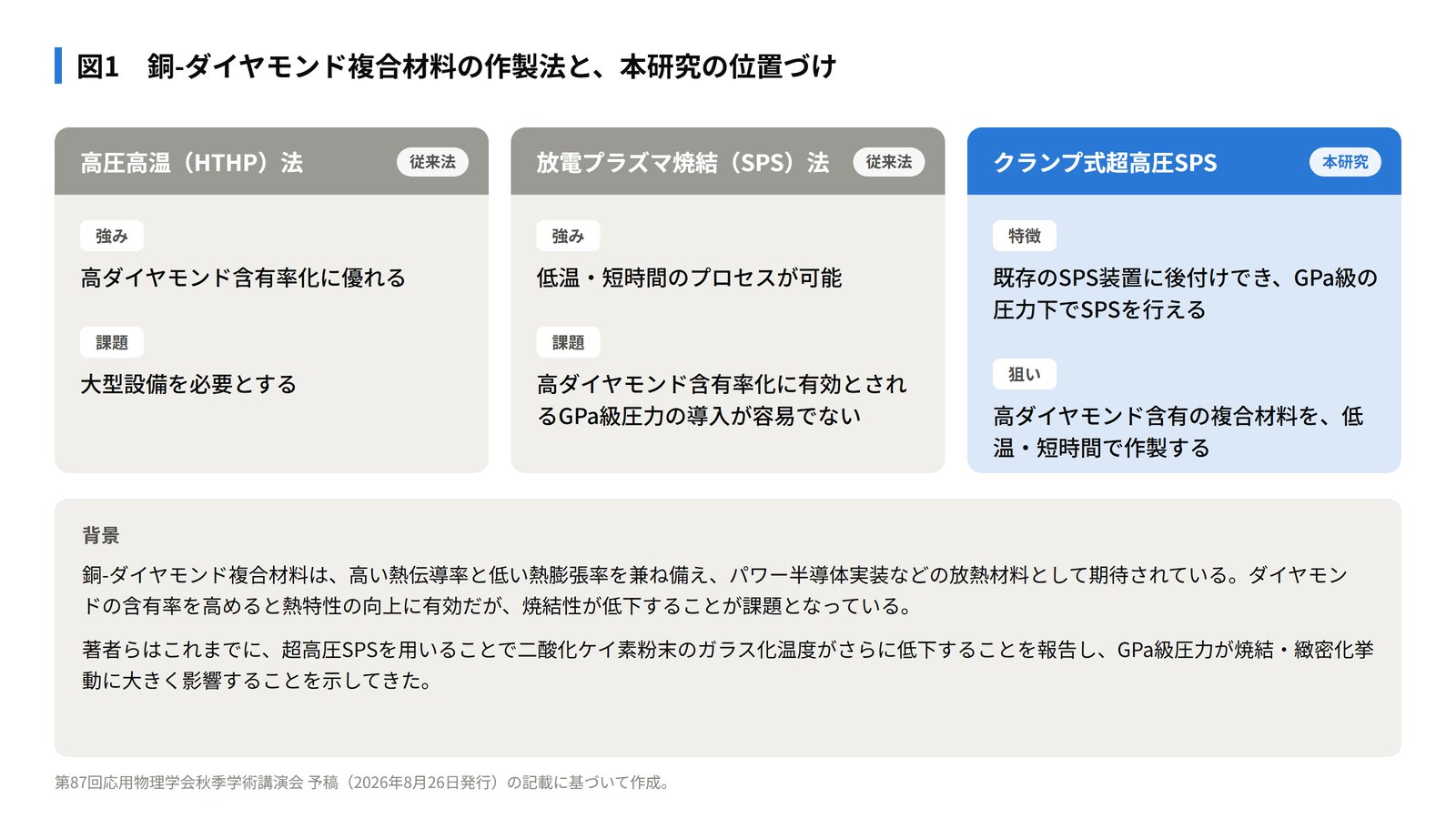
Background: the more diamond, the harder to sinter
Copper–diamond composites combine high thermal conductivity with low thermal expansion and are expected to serve as heat-dissipating materials for applications such as mounting power semiconductors. Raising the diamond content improves thermal properties, but it also lowers sinterability.
Copper–diamond composites have been made by hot pressing, spark plasma sintering (SPS) and high-pressure high-temperature (HPHT) methods. HPHT excels at high diamond content but requires large equipment. SPS enables low-temperature, short processes, but introducing the GPa-class pressure considered effective for high diamond content has not been easy.
Professor Mori and colleagues have previously reported that ultra-high-pressure SPS further lowers the vitrification temperature of silicon dioxide powder, showing that GPa-class pressure strongly affects sintering and densification behavior.
The presentation
In this study, the team made a preliminary examination of whether copper–diamond composites with high diamond content can be fabricated at low temperature in a short time, using a clamp-type ultra-high-pressure SPS unit that can be retrofitted to an existing SPS machine.
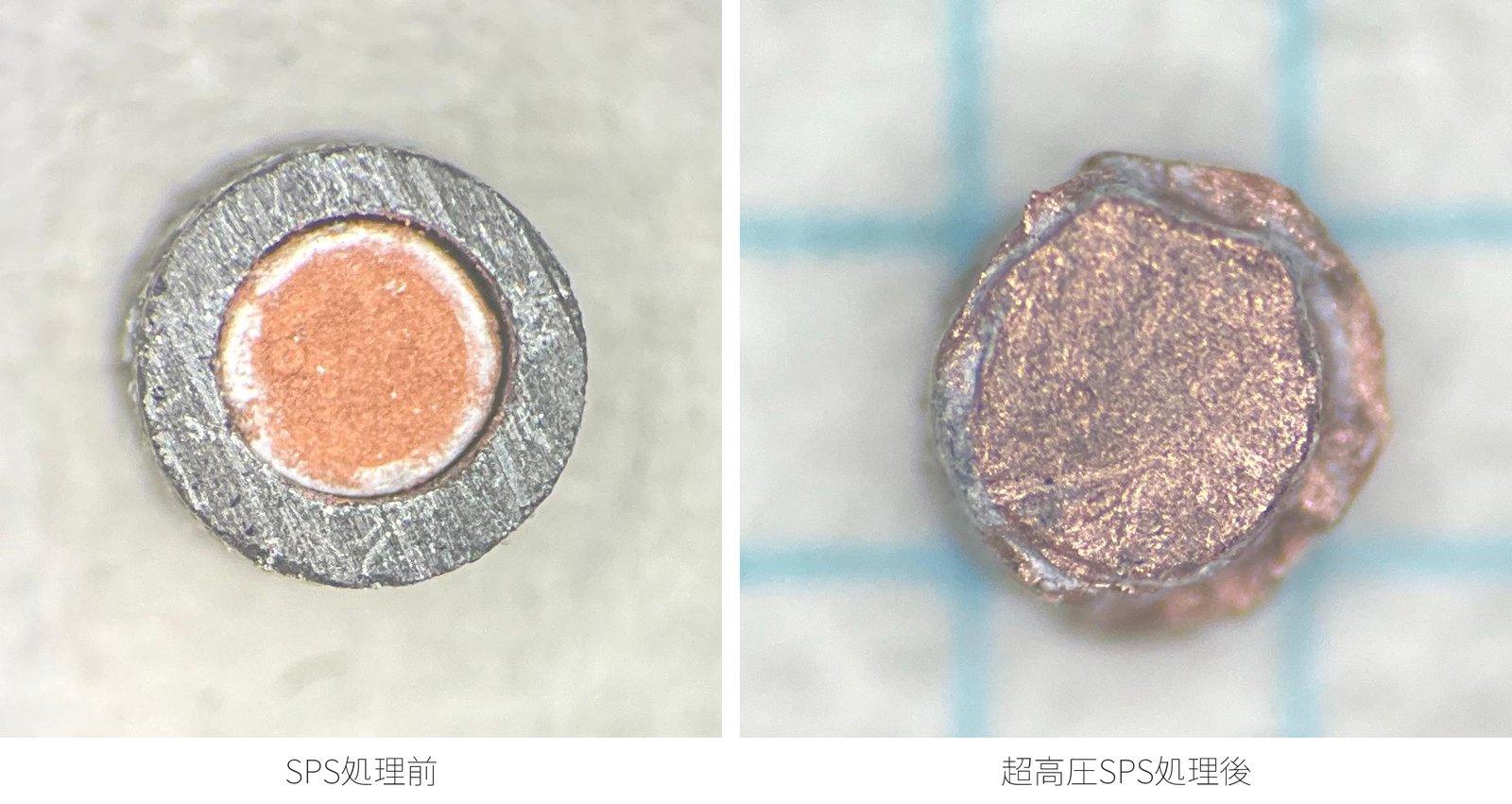
Method. Copper and diamond powders with an average particle size of about 5 μm were used. Diamond content was set at three levels—20, 40 and 60 vol%—and the mixed powders were packed into boron nitride (BN) tubes and sintered with the clamp-type ultra-high-pressure SPS unit. The pressure in the clamped state was evaluated by room-temperature calibration using the change in electrical resistance of bismuth. Sintering conditions were an estimated pressure of 2 GPa or more in the heated state, a heating rate of 30 °C/min, a sintering temperature of 700 °C and a five-minute hold.
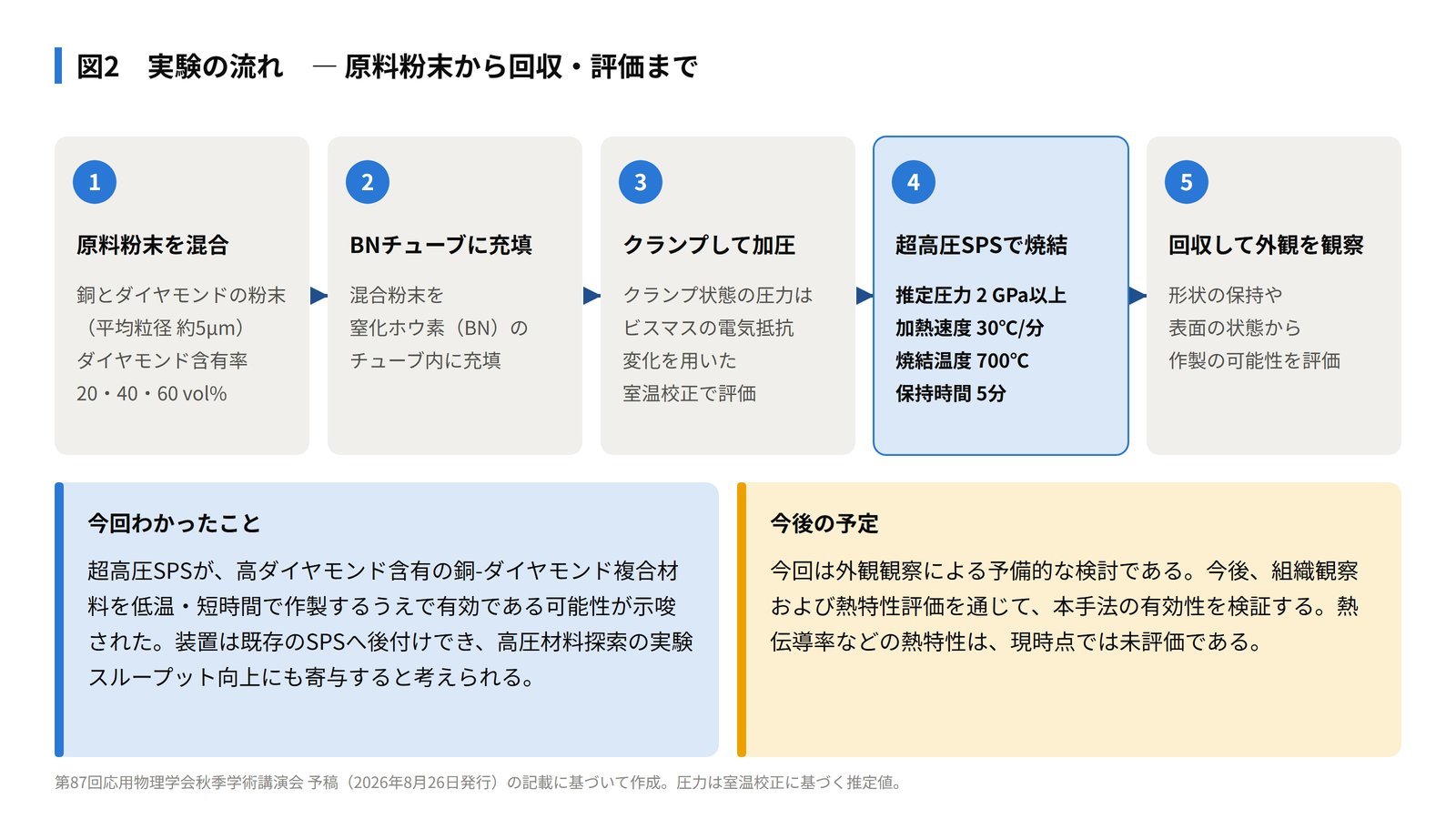
Results. The feasibility of fabrication was evaluated by visual inspection of the samples. At 20–40 vol% diamond, samples were recovered with their shape intact. At 60 vol%, the shape was retained, but powdery shedding due to surface wear was observed.
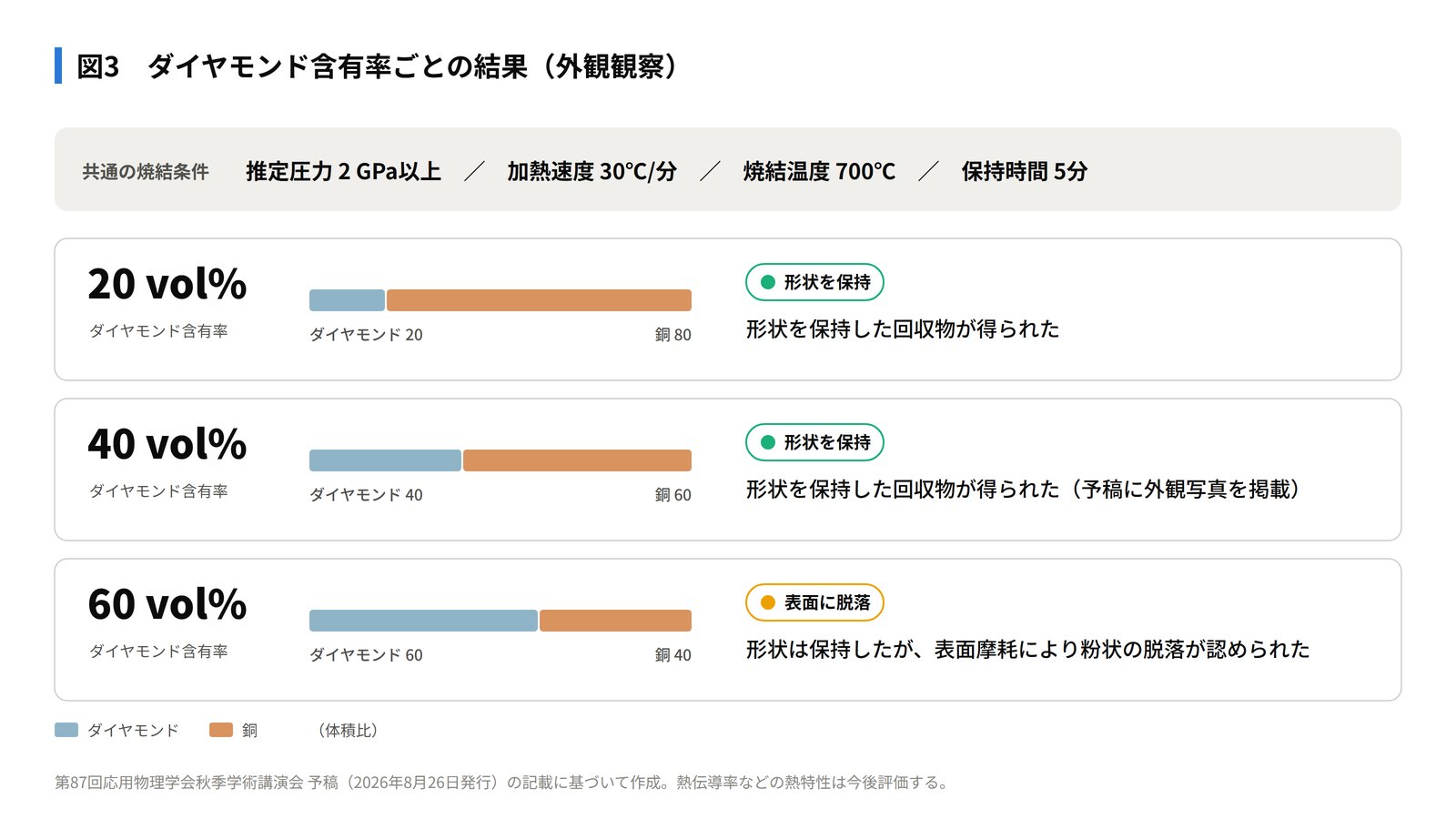
These results suggest that ultra-high-pressure SPS may be effective for fabricating copper–diamond composites with high diamond content at low temperature in a short time. Because the unit can be retrofitted to existing SPS machines, it may also help raise experimental throughput in high-pressure materials exploration.
Next steps
This presentation is a preliminary study based on visual inspection. The team will verify the effectiveness of the method through microstructural observation and thermal-property evaluation.
Related patent applications
On August 22, 2026, the Company and Yoshihisa Mori jointly filed the following two patent applications on technologies related to this presentation:

- High-pressure generating apparatus, high-pressure sintering apparatus, high-pressure sintering unit, parts set, and method for producing a sintered body (Japanese Patent Application No. 2026-192206)
- Method for producing a composite heat-dissipating member, and composite heat-dissipating member (Japanese Patent Application No. 2026-192205)
*This announcement does not mean that patents have been granted.
Comment

“Getting heat out is an unavoidable challenge in drawing out the performance of power semiconductors. This presentation is still at a preliminary stage, but we were able to show that sintering under GPa-class pressure can be tried by retrofitting existing equipment rather than relying on large high-pressure facilities. We will proceed with microstructural and thermal-property evaluation and report results as they become available.”
—Kengo Suzuki, Representative Director and CEO, Space Seed Holdings Inc.
Glossary
- Spark plasma sintering (SPS): a method of sintering powder quickly by passing pulsed DC current through it under pressure.
- GPa (gigapascal): 1 GPa is about 10,000 atmospheres.
- High-pressure high-temperature (HPHT) method: synthesizing or sintering materials under high pressure and temperature using large high-pressure equipment.
- Clamp type: a method that holds the pressurized state by tightening with screws or similar.
- Volume percent (vol%): the proportion of the total volume of a material.
About Space Seed Holdings Inc.
Space Seed Holdings Inc. is a space-focused deep-tech venture builder whose mission is “Turning science fiction into nonfiction.” Its core business is R&D related to SpaceAgent, a platform that can conduct research autonomously both in space and on the ground, and through operating the “Fermentation and Longevity Fund” program, which supports the social implementation of fermentation and longevity technologies, it creates businesses that address societal challenges. Together with diverse stakeholders, it aims to assemble by 2040 the technologies humankind needs to live in space.
https://ss-hd.co.jp/