
Patent Application Filed for a High-Pressure Sintering Apparatus That Combines GPa-Class Pressure and Current-Assisted Sintering on a General-Purpose Materials Testing Machine
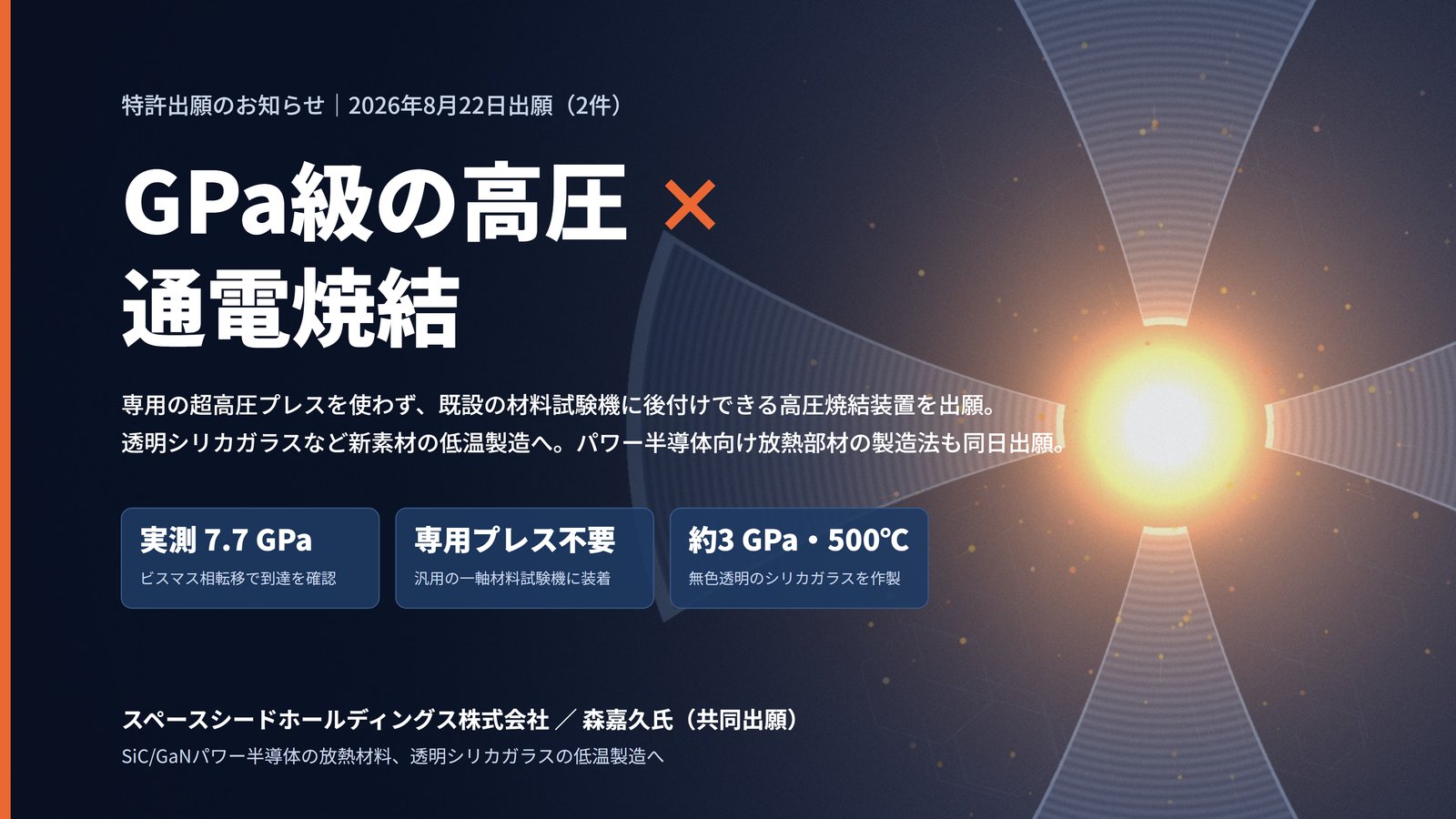
Space Seed Holdings Inc. (Headquarters: Minato-ku, Tokyo; Representative Director and CEO: Kengo Suzuki; “the Company”) filed the following two patent applications on August 22, 2026, jointly with Professor Yoshihisa Mori of Okayama University of Science:
- “High-pressure generating apparatus, high-pressure sintering apparatus, high-pressure sintering unit, parts set, and method for producing a sintered body” (Japanese Patent Application No. 2026-192206)
- “Method for producing a composite heat-dissipating member, and composite heat-dissipating member” (Japanese Patent Application No. 2026-192205)
This announcement introduces the high-pressure sintering apparatus of the first application. The second application concerns a composite heat-dissipating member intended for mounting SiC/GaN power semiconductors; details will be disclosed as the patent prosecution progresses.
Highlights
- No dedicated ultra-high-pressure press required. The application covers an apparatus that attaches to an existing uniaxial materials testing machine and performs spark plasma sintering (SPS) under GPa-class pressure (tens of thousands of atmospheres). With this apparatus family (a clamp-type pressing mechanism), a pressure of 7.7 GPa has been confirmed by measurement.
- Pressure held during heating; consumables replaced in one motion. Elastic members such as disc springs absorb thermal expansion during heating to maintain preload, and the anvil tips are detachable modules with a tapered fit, so a single push both positions the tip and forms the electrical contact.
- Transparent silica glass at about 3 GPa and 500 °C. Colorless, transparent amorphous glass was obtained without melting, at a temperature far below the roughly 1,700 °C or more typically needed to melt quartz glass.
Background: why high pressure and current-assisted sintering have been hard to combine
Heating materials under several GPa or more is known to yield dense sintered bodies, metastable phases and transparent glasses that cannot be obtained at ambient pressure. Spark plasma sintering (SPS), which passes pulsed direct current through powder so that heat generated between particles densifies it quickly, is widely used to obtain sintered bodies at relatively low temperature and in a short time.
However, general-purpose SPS machines apply only tens to hundreds of MPa, so combining GPa-class pressure and SPS in one machine has not been easy. GPa-class pressure has required a dedicated ultra-high-pressure press, whose cost and footprint have limited adoption. Equipment that heats samples electrically under high pressure has also faced practical problems:
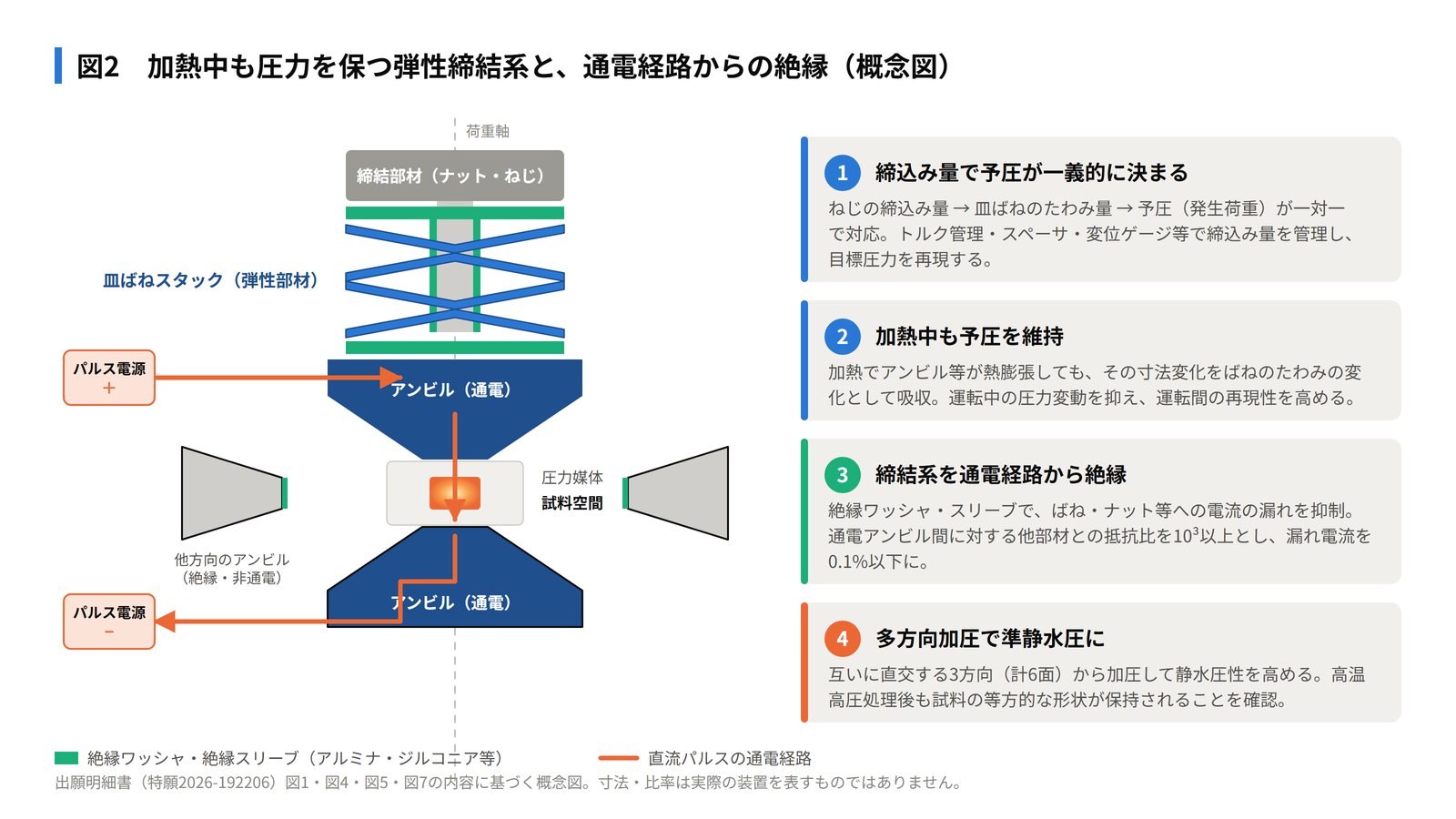
- Thermal expansion of components during heating changes the clamping force (preload), so sample pressure fluctuates during operation
- Because the loading axis itself carries the current, insulating it to prevent current leaking into the pressing and clamping parts is difficult
- When anvil tips, which wear quickly under high pressure, are replaced, it is hard to reproduce their alignment and electrical contact
Professor Mori and colleagues, who study high-pressure generation, have proposed apparatus that presses a sample from several directions with multiple anvils while passing current through those anvils. The present application builds on that apparatus family and protects concrete mechanisms that solve the problems above.
Application 1: GPa-class SPS without a dedicated ultra-high-pressure press
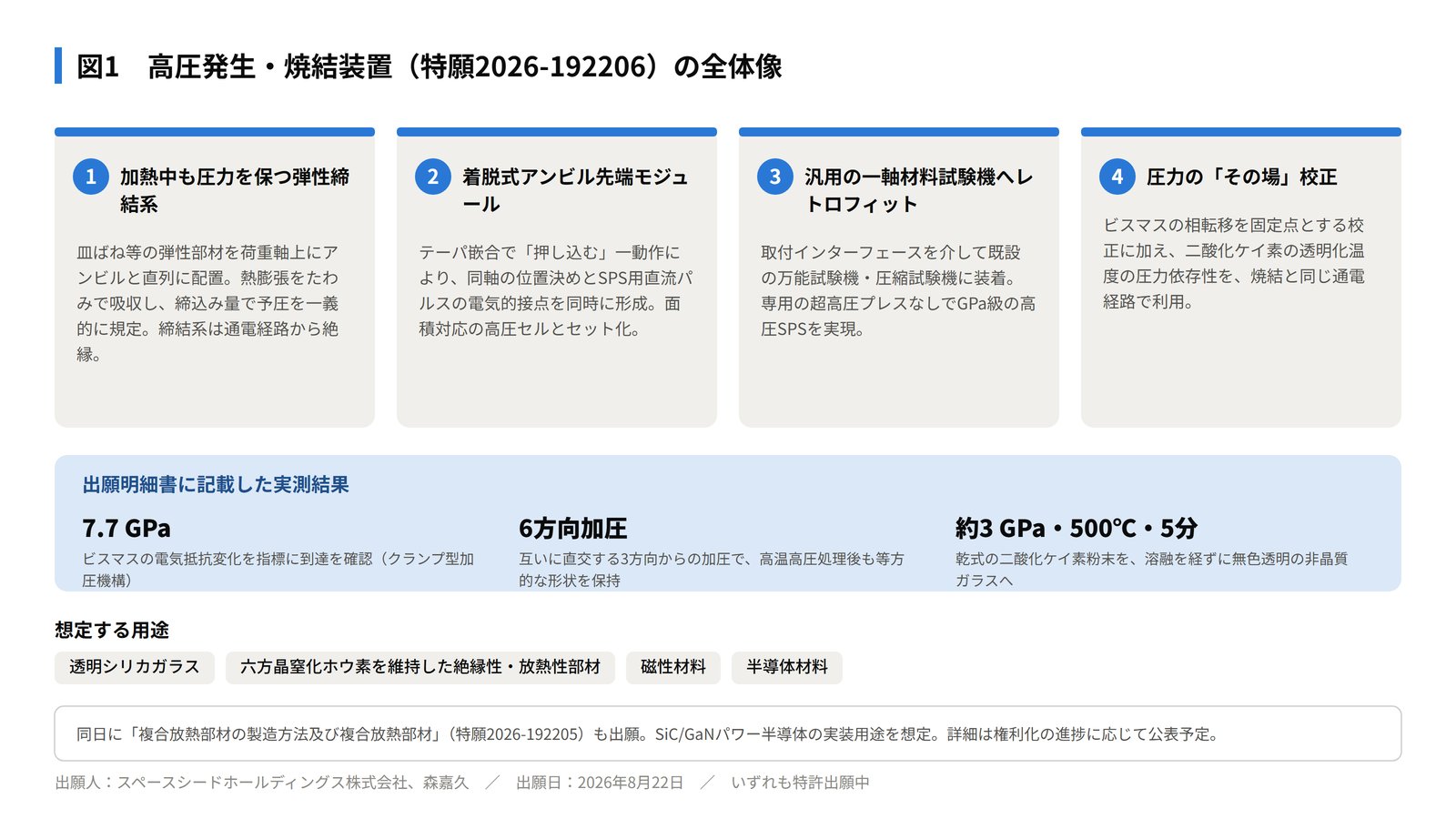
The apparatus has four features.
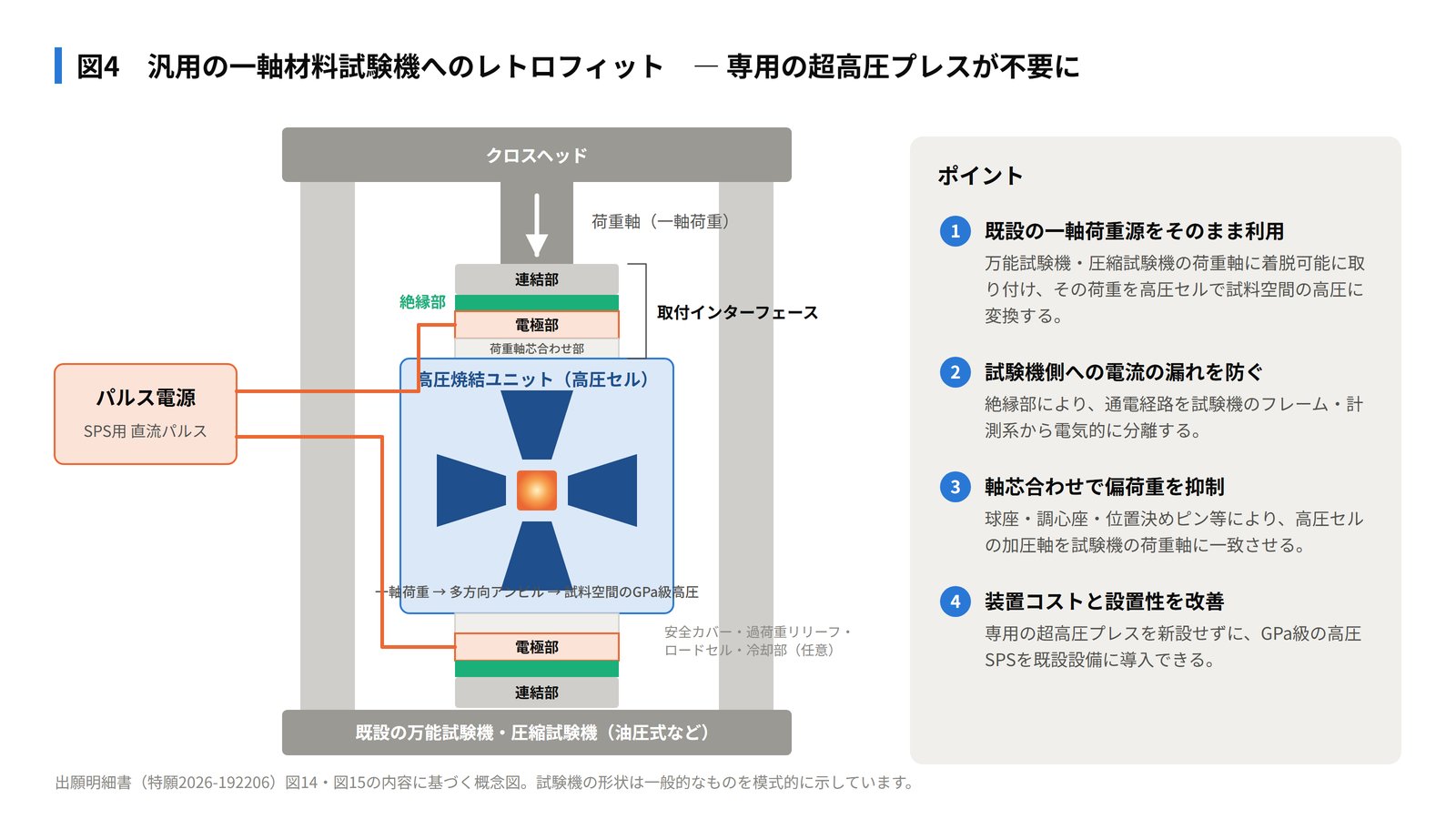
1. An elastic clamping system that holds pressure during heating. Elastic members such as disc springs are placed in series with the anvils on the loading axis. Dimensional changes from thermal expansion are absorbed as changes in spring deflection, so preload is maintained during heating. Because preload is uniquely determined by the tightening amount, target pressures are easy to set and reproduce. The elastic and clamping members are electrically insulated from the current path, suppressing current leakage into the pressing and clamping system.
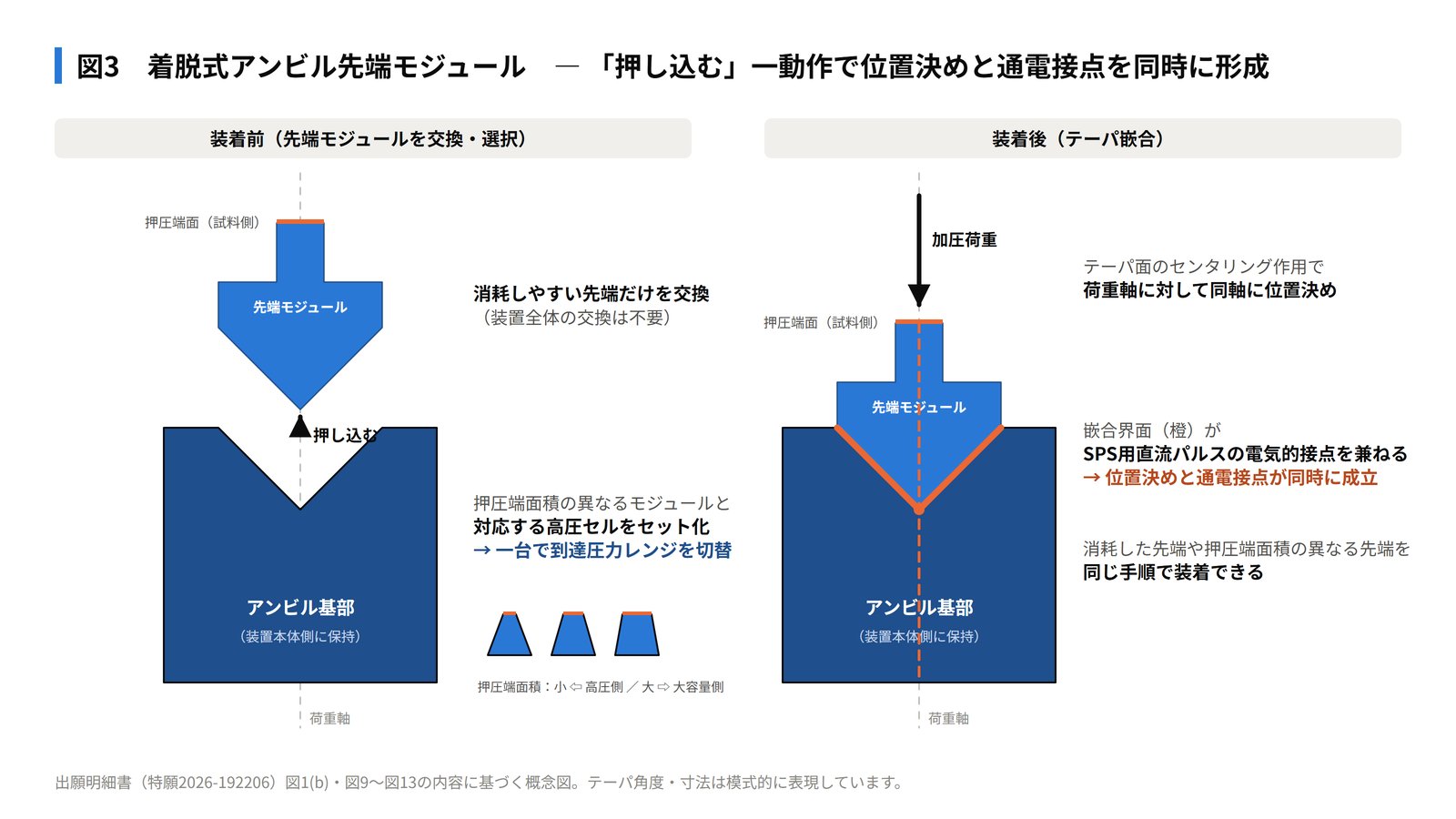
2. Detachable anvil-tip modules. The anvil tips, which wear easily, are modularized and mounted with a tapered fit. A single push achieves coaxial alignment with the loading axis and forms the electrical contact for the SPS DC pulses at the same time. By supplying modules with different pressing-face areas together with matching high-pressure cells, one apparatus body can switch between attainable pressure ranges.
3. Retrofit to a general-purpose uniaxial testing machine. Through a mounting interface, the unit attaches to the loading axis of an existing universal or compression testing machine, and the high-pressure cell converts that load into high pressure in the sample space. GPa-class SPS becomes possible without a dedicated press, which is expected to reduce equipment cost and ease installation.
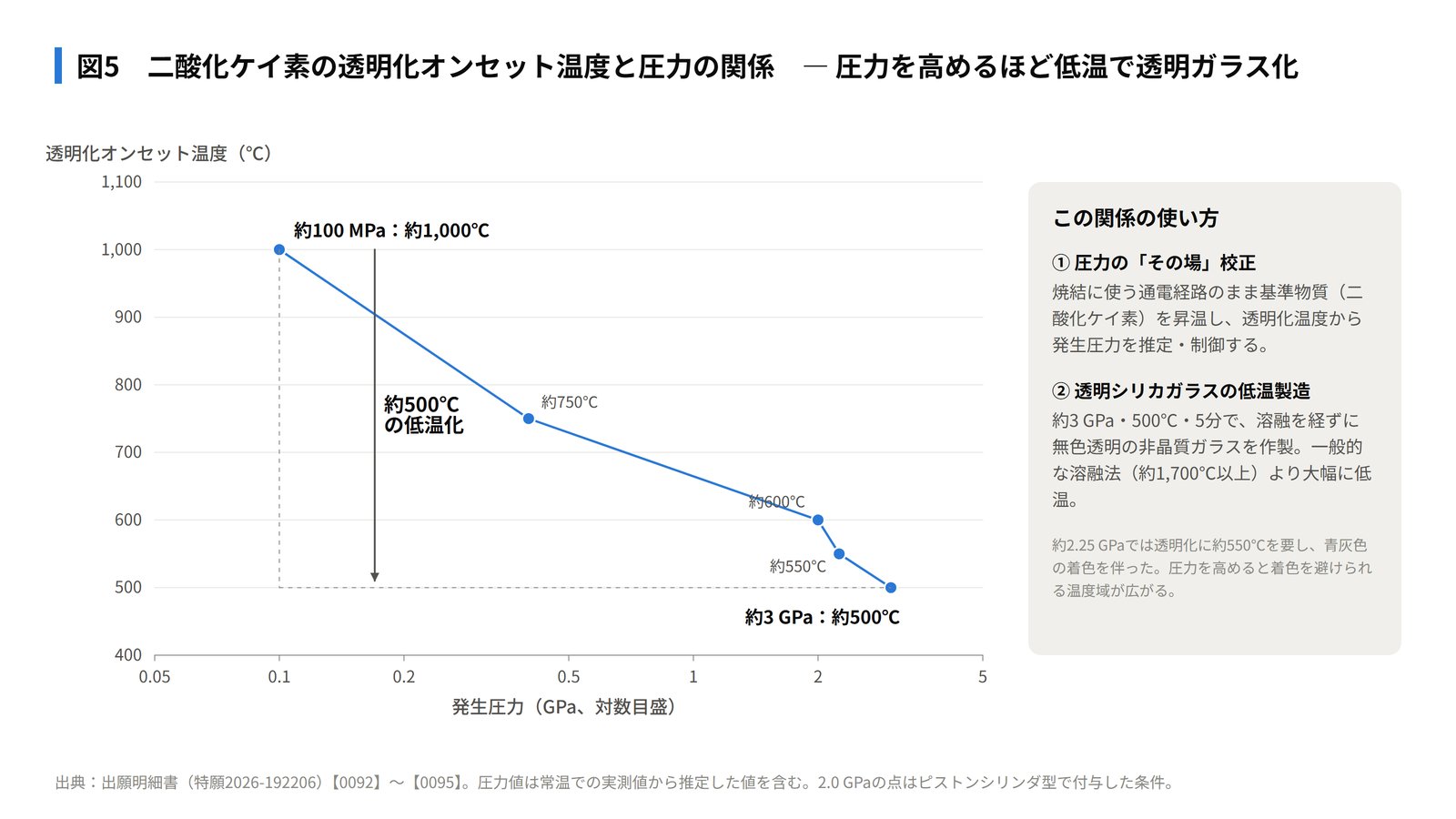
4. In-situ pressure calibration. In addition to estimating and calibrating the generated pressure using pressure-induced phase transitions of bismuth as fixed points, the application includes a method that estimates and controls pressure through the same current path used for sintering. It exploits the fact that the temperature at which silicon dioxide turns from opaque to transparent when heated under pressure (the transparency-onset temperature) decreases as pressure rises.
Results described in the specification. In the clamp-type mechanism, a pressure of 7.7 GPa was confirmed using the change in electrical resistance of bismuth as an indicator. Pressing from three mutually orthogonal directions (six opposing faces) was confirmed to preserve the isotropic shape of the sample after high-temperature, high-pressure treatment. Using the apparatus, dry silicon dioxide powder treated at about 3 GPa, a maximum of 500 °C and a five-minute hold yielded colorless, transparent amorphous glass without melting—far below the roughly 1,700 °C or more typically required to melt quartz glass.
Intended applications include transparent silica glass, insulating and heat-dissipating components that retain the crystal structure of hexagonal boron nitride, magnetic materials, and semiconductor materials.
Application 2: composite heat-dissipating member
The second application concerns a composite heat-dissipating member for mounting SiC/GaN power semiconductors and its manufacturing method. SiC and GaN power devices underpin efficiency gains in automotive inverters, data-center power supplies and power conversion for renewable energy. Because they operate at higher temperatures and heat fluxes than silicon, the heat-dissipating member strongly affects device performance and reliability. The Company is extending its high-pressure science know-how to this field; the material composition and manufacturing conditions of Application 2 will be disclosed as prosecution progresses.
Outlook
Centered on securing rights to the apparatus, the Company will work to bridge high-pressure science to industrial materials, and will consider joint research and evaluation with equipment makers, materials makers and research institutions, as well as commercialization through licensing.
Application overview

- Titles of invention: (1) High-pressure generating apparatus, high-pressure sintering apparatus, high-pressure sintering unit, parts set, and method for producing a sintered body; (2) Method for producing a composite heat-dissipating member, and composite heat-dissipating member
- Application numbers: Japanese Patent Application Nos. 2026-192206 and 2026-192205
- Filing date: August 22, 2026 (both)
- Applicants: Space Seed Holdings Inc.; Yoshihisa Mori
- Inventors: Yoshihisa Mori; Kengo Suzuki
*This announcement concerns the filing of patent applications and does not mean that patents have been granted.
Glossary
- Spark plasma sintering (SPS): a sintering method that passes pulsed DC current through powder under pressure, densifying it quickly through discharge and Joule heating between particles.
- GPa (gigapascal): 1 GPa is about 10,000 atmospheres. Typical SPS machines apply 0.1 GPa or less.
- Quasi-hydrostatic pressure: a state in which pressing from several directions at once reduces stress differences among the three axes, compressing the sample isotropically.
- Anvil: an ultra-hard member that presses the sample.
- Preload: compressive force applied to the loading axis in advance by clamping.
Comment from the CEO

“High-pressure science has long known that GPa-class pressure gives materials new properties, but the benefits have stayed in a small number of labs that own large, dedicated equipment. This application makes it possible to reproduce that environment on an existing testing machine. We are also working on putting this environment to use in making new materials, and will share progress as it comes.”
—Kengo Suzuki, Representative Director and CEO, Space Seed Holdings Inc.
About Space Seed Holdings Inc.
Space Seed Holdings Inc. is a space-focused deep-tech venture builder whose mission is “Turning science fiction into nonfiction.” Through investment, research and venture creation—centered on operating the “Fermentation and Longevity Fund” program, which supports the social implementation of fermentation and longevity technologies—the company creates businesses that address societal challenges. Together with diverse stakeholders, it aims to assemble by 2040 the technologies humankind needs to live in space.
https://ss-hd.co.jp/