
Patent Application Filed for a Method of Selecting Koji Mold Strains for Fermented Sweeteners, Combining DNA Markers with Enzyme Activity

Regenesome Inc. (Headquarters: Minato-ku, Tokyo; President: Zentaro Sakuma; “Regenesome”), a longevity-tech venture in the group of Space Seed Holdings Inc. (Headquarters: Minato-ku, Tokyo; Representative Director and CEO: Kengo Suzuki), has filed a patent application with the Japan Patent Office on August 31, 2026, jointly with Kanazawa Institute of Technology (Nonoichi, Ishikawa) and Oryze (Shibuya-ku, Tokyo). The invention is a method for efficiently selecting koji mold strains suited to producing fermented sweeteners such as amazake and sweet koji.
Background
Koji mold (Aspergillus oryzae) is indispensable to Japanese fermented foods such as sake, miso, soy sauce and amazake. Amazake, sweet koji and rice-koji sweeteners—made without sugar by using koji enzymes to break down rice starch into sugars—are drawing attention in Japan and abroad as “fermented sweeteners” with a natural sweetness.
Their sweetness and quality depend heavily on saccharifying enzymes, above all the alpha-amylase that koji mold secretes. However, the koji genome carries several alpha-amylase genes that are more than 99% identical to one another, which makes them difficult to tell apart by ordinary PCR. Gene copy number alone is also known not to determine enzyme output, so strain selection has had to rely on factory experience or large-scale whole-genome sequencing.
The invention
The invention focuses on the regions surrounding the three alpha-amylase loci of koji mold. It combines PCR amplification patterns obtained with primer pairs that can distinguish each region (molecular markers) with saccharification-related enzyme activity after koji making (phenotype), so that strains suited to fermented sweeteners can be selected more simply and objectively than by sequencing. The procedure is:
- Obtain PCR amplification patterns for the regions around the three alpha-amylase loci from the genomic DNA of the test strains
- Narrow down candidates to strains whose patterns differ from the reference strain (RIB40)
- Measure saccharification-related phenotype values, such as alpha-amylase activity, in rice koji made with the candidate strains
- Select strains whose phenotype values exceed those of the reference as koji molds for fermented-sweetener production
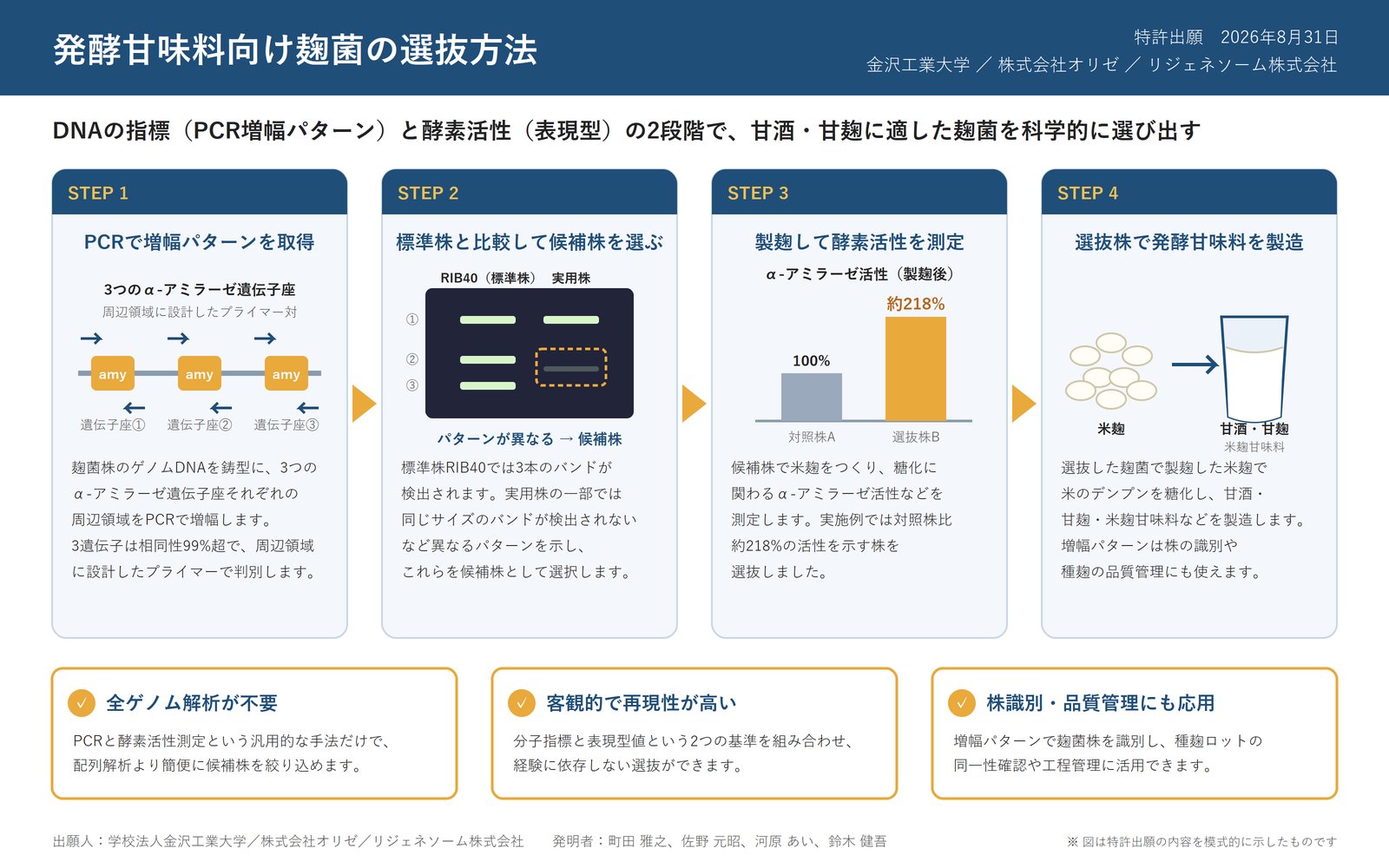
In the examples, the method selected a practical strain showing about 2.2 times (about 218%) the alpha-amylase activity of the control strain, and amazake was successfully produced using rice koji made with that strain.
The PCR amplification patterns can also be used to identify koji strains, for example to confirm the identity of seed-koji lots and for quality control in production. Besides the selection method, the application covers a strain identification method, an identification reagent set, a discrimination kit, and methods for producing rice koji and fermented sweeteners with the selected strains.
Features
- Simplicity: candidates are narrowed down and selected with widely used methods—PCR and enzyme-activity measurement—without whole-genome sequencing.
- Objectivity: combining two objective criteria, molecular markers and phenotype values, enables reproducible selection that does not depend on individual experience.
- Extensibility: the same approach applies beyond alpha-amylase to other secreted hydrolases such as proteases and lipases, so strains can be chosen for target tastes and aromas.
- Quality control: strain identification by amplification pattern can be used to verify seed-koji identity and manage lots.
Application overview

- Title of invention: Method for selecting koji mold used in producing fermented sweeteners, method for identifying koji mold strains, reagent set, discrimination kit, method for producing rice koji, and method for producing fermented sweeteners
- Filing date: August 31, 2026
- Applicants (joint): Kanazawa Institute of Technology; Oryze; Regenesome Inc.
- Inventors: Masayuki Machida (Kanazawa Institute of Technology), Motoaki Sano (Kanazawa Institute of Technology), Ai Kawahara (Oryze), Kengo Suzuki (Regenesome)
- International Patent Classification: C12Q 1/6895, C12Q 1/686, C12N 1/14
*This announcement concerns the filing of a patent application and does not mean that a patent has been granted.
Outlook
Regenesome will use the invention in developing fermentation-related technologies for longevity, and, together with Kanazawa Institute of Technology and Oryze, will work to add value to fermented foods by using koji genome information.
About Regenesome Inc.
Regenesome aims to deliver new solutions for aging control and regenerative medicine using nanoparticles. It has opened its headquarters and laboratory, the Takanawa Longevity Lab, at LiSH (Link Scholars’ Hub) in TAKANAWA GATEWAY CITY, and is developing a healthcare business under its own brand “Saisei Lab” while accelerating R&D toward future medical applications. Its long-term aim is to contribute both to longer healthy life expectancy and to humanity’s expansion into space.
https://regenesome.com/
About Space Seed Holdings Inc.
Space Seed Holdings Inc. is a space-focused deep-tech venture builder whose mission is “Turning science fiction into nonfiction.” Through investment, research and venture creation—centered on operating the “Fermentation and Longevity Fund” program, which supports the social implementation of fermentation and longevity technologies—the company creates businesses that address societal challenges. Together with diverse stakeholders, it aims to assemble by 2040 the technologies humankind needs to live in space.
https://ss-hd.co.jp/