
Development of an “Ultra-High-Pressure SPS Apparatus” Stably Generating Over 10 GPa — Toward Low-Temperature Material Synthesis with Okayama University of Science
Space Seed Holdings Inc. (Headquarters: Minato-ku, Tokyo; CEO: Kengo Suzuki, “the Company”) announces that, in joint research with Professor Yoshihisa Mori and colleagues at Okayama University of Science, it has developed a new type of spark plasma sintering (SPS) apparatus capable of stably generating ultra-high pressures of 10 GPa or more. The results were presented at the 2026 Spring Meeting of the Japan Society of Powder and Powder Metallurgy (late May 2026, Osaka; presentation no. 3-9A).
The presentation, titled “Development of an Ultra-High-Pressure SPS Apparatus Combined with a Clamp-Type High-Pressure Generator,” was given by Yoshihisa Mori¹, Kanji Kameyama¹, and Kengo Suzuki² (1. Okayama University of Science; 2. Space Seed Holdings Inc.).
Background: The “Quantitative Evaluation Wall” in Ultra-High-Pressure Sintering
SPS (Spark Plasma Sintering) is a forming method in which a pulsed current is passed through uniaxially pressed powder to consolidate it into a dense solid in a short time and at low temperature. Under applied pressure, materials behave differently than at ambient pressure. The research group has previously reported that applying pressure substantially lowers the vitrification temperature of SiO₂ (silicon dioxide).
However, with conventional piston-cylinder ultra-high-pressure SPS, samples were extremely small—on the sub-millimeter scale—and the distributions of pressure and temperature tended to be non-uniform. This made it difficult to quantitatively evaluate “at what pressure and what temperature each phenomenon occurred.”
The Achievement: An Ultra-High-Pressure SPS Apparatus Combined with a Clamp-Type High-Pressure Generator
Building on a “palm cubic” configuration that applies pressure isotropically to the sample using six anvils, the research group newly developed a clamp-type high-pressure generator. This makes it possible to handle larger samples than before under a uniform pressure field.
For pressure calibration, the phase transitions of bismuth (Bi) were used as pressure fixed points. Under a 30-ton load, by controlling the torque of four clamp screws, the group confirmed the Bi II–III transition (2.70 GPa) at a torque of 100 N·m and the Bi I–II transition (2.55 GPa) at 50 N·m. Heating to near 1273 K is possible with a current of approximately 100 A; at 70 A, only the region near the sample reaches high temperature, forming a thermally insulating structure that suppresses temperature rise in the apparatus body.
In verification, SiO₂ was sintered by SPS, and the recovered sample reached the millimeter scale—approximately 2 mm in diameter and 1 mm in height—a substantial increase over conventional methods. Furthermore, transparent vitrification was confirmed under the low-temperature conditions of 75 N·m torque and 873 K. This is comparable to the result obtained at approximately 2 GPa and 873 K with the conventional piston-cylinder type.
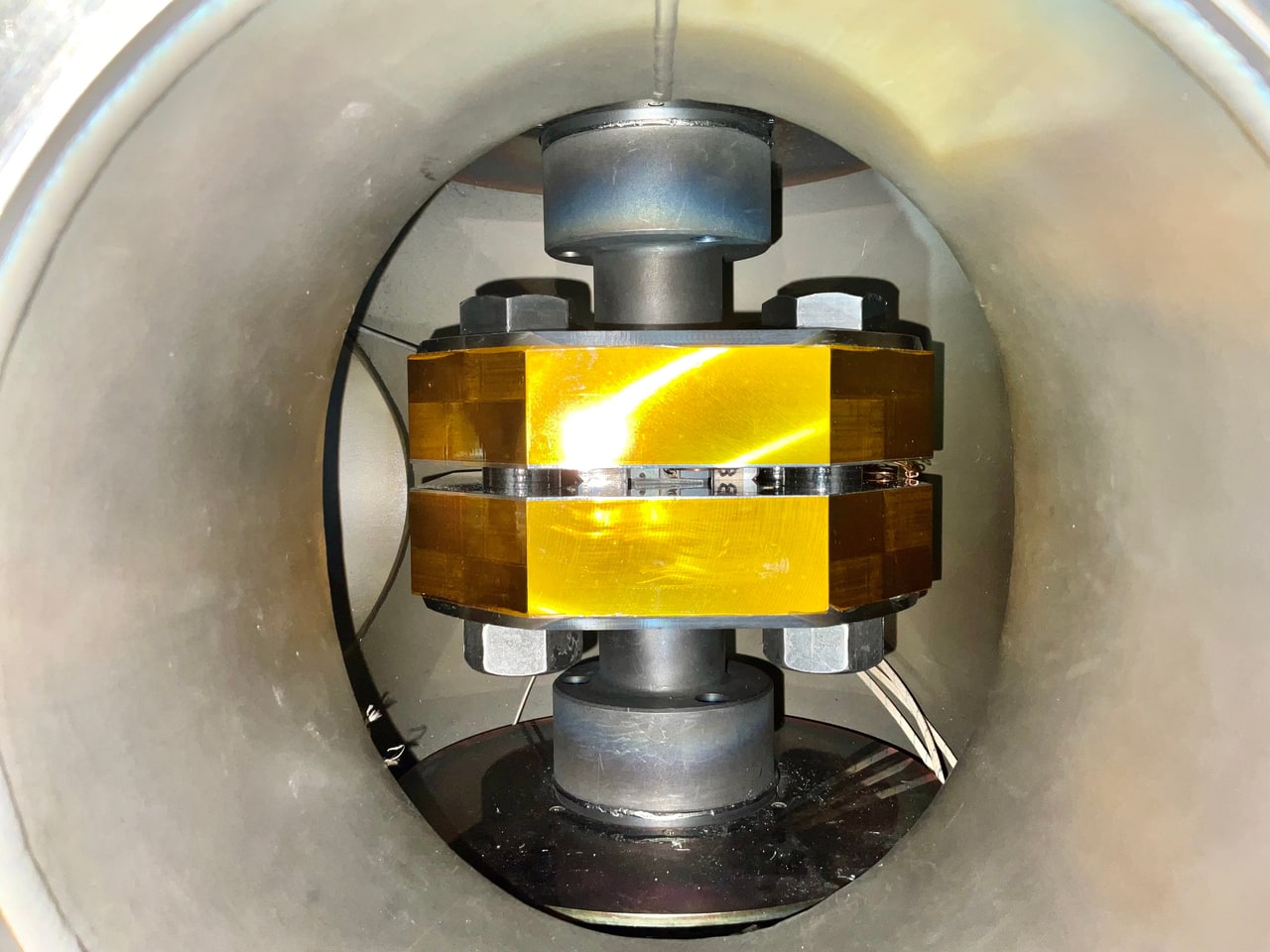
Technical Highlights
・Stable generation above 10 GPa: The six-anvil palm cubic structure is applied in a clamp-type design to stably generate ultra-high pressures.
・Uniform pressure field and large-volume samples: With a uniform pressure distribution, the apparatus can handle millimeter-scale samples that are larger than those of conventional methods.
・Pressure calibration via bismuth phase transitions: The phase transitions of Bi are used as pressure fixed points to quantitatively determine the generated pressure.
・Thermally insulating structure with localized heating: Heating to near 1273 K is possible at 100 A. At 70 A, high temperature is localized only near the sample, suppressing temperature rise in the apparatus body.
・Transparent vitrification confirmed at lower temperature and pressure: This demonstrates that pressure is not merely a densification factor but a “design factor that controls the state of a material.”
Anticipated Use Cases
The apparatus is expected to be useful for low-temperature synthesis of new materials, control of non-equilibrium states, and the search for materials synthesized under high pressure, such as diamond and c-BN (cubic boron nitride). The aim is to move material development—previously a matter of “you couldn’t know until you made it”—into a stage where materials can be designed with conditions in clear view.
Outlook
Going forward, the research group will advance pressure identification under heated conditions and further improve the accuracy of pressure and temperature calibration. The Company will continue its joint research with Professor Yoshihisa Mori, accumulate material-synthesis data, and extend the work into its own material and process development, including the space-utilization research business “SPACE LAB.” The Company has filed a patent application for this next-generation high-pressure SPS technology and will use it as a foundation for both securing rights and commercialization.
Comment from the CEO
Pressure is not merely a force for compressing and hardening things. We want to treat pressure as “a pen that rewrites the very state of a material.” Through this apparatus development pursued together with Professor Yoshihisa Mori, ultra-high-pressure sintering—where it had been difficult to measure conditions accurately—can now be carried out under uniform pressure and yield millimeter-sized samples. We find great significance in having reached the entrance to designing materials with conditions in clear view. The long-term goal that SS-HD pursues is to assemble, by 2040, the technologies necessary for humankind to live in space. In space, where the materials that can be carried from Earth are limited, technologies that produce the needed materials from on-site resources with low energy are indispensable. This apparatus, which skillfully uses pressure to synthesize materials at low temperature, could become one of the foundational technologies for that future. “Turning Science Fiction into Nonfiction”—we will advance that journey one step at a time through solid experimentation and verification.
—Kengo Suzuki, Representative Director and CEO, Space Seed Holdings Inc.
About Space Seed Holdings Inc.
Space Seed Holdings Inc. is a space-focused deep-tech venture builder with the mission of “Turning Science Fiction into Nonfiction.” The company engages in investment, research, and venture creation, centered on operating the “Fermentation and Longevity Fund,” which supports the social implementation of fermentation and longevity technologies to address societal challenges. In collaboration with diverse stakeholders, Space Seed Holdings aims by 2040 to assemble the technologies necessary for sustained human habitation in space.
https://ss-hd.co.jp