
Next-Generation SPS × MI Materials Project
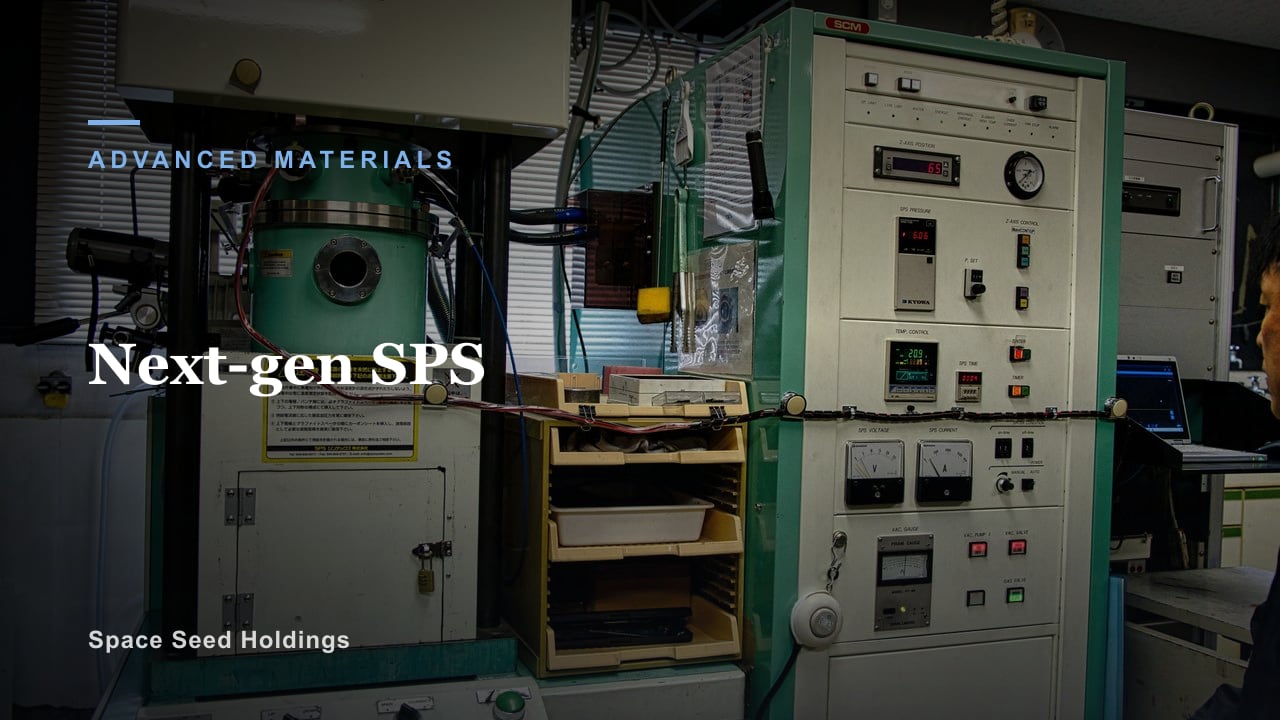
Joint research with Prof. Yoshihisa Mori (Okayama Univ. of Science): a benchtop ultra-high-pressure SPS.
Overview
The Next-Generation SPS Materials Project is a joint research effort between Space Seed Holdings and Professor Yoshihisa Mori of Okayama University of Science. By developing a benchtop-scale next-generation SPS device that enables sintering far beyond the pressure limits of conventional Spark Plasma Sintering, the project aims to develop advanced materials at high throughput and bring them into society.
Direction
- An ultra-high-pressure SPS platform: We aim to establish an Ultra-High-Pressure Spark Plasma Sintering (UHP-SPS) platform that integrates a Palm-type cubic anvil with SPS, combining anvils that apply pressure evenly from three axes with electrical-current sintering.
- Exploring new materials: The scope includes functional materials such as superhard materials, transparent ceramics and semiconductor materials. Synthesis of hard materials from bio-derived feedstock, and lightweight high-strength materials envisaged for use in space or on the Moon, are considered as future application images.
- Distributed research through benchtop design: Modularising the device to a benchtop scale supports high-throughput materials development across multiple sites.
The scientific grounding
What Spark Plasma Sintering (SPS) is
Spark Plasma Sintering (SPS) is a pressure-assisted sintering method that applies “pressure” and “heating by pulsed direct current” to powder simultaneously, consolidating it into a dense solid. Because it uses resistive heating from the current (Joule heating), it can ramp up at hundreds to a thousand degrees per minute; the short sintering time suppresses grain growth and makes it easier to preserve fine microstructures and nanostructures. The ability to densify at low temperature in a short time is why it suits the exploration of hard-to-sinter materials and novel phases.
The limits of conventional SPS and the idea behind UHP-SPS
Commonly available SPS equipment is generally limited to around 0.1 GPa (100 MPa), placing a physical ceiling on the search for hard-to-sinter materials and for phases that appear only under high pressure. Building on an invention by Professor Yoshihisa Mori of Okayama University of Science, this joint research gives concrete form to a device concept that enables current-assisted sintering in the ultra-high-pressure range (UHP-SPS): it combines a Palm-type cubic anvil able to apply pressure evenly from three orthogonal axes with a structure that sinters by DC pulsed current while under pressure. The design intent points toward the 10 GPa class — covering, for example, the 5 GPa / 1500°C region of diamond synthesis. Securing uniform pressure and temperature distribution through evenly applied tri-axial pressure is cited as an advantage over conventional piston-cylinder types.
A demonstrated technical milestone
As a result showing the effectiveness of this device concept, the team of Space Seed Holdings and Professor Mori succeeded in synthesising a large-area, highly uniform transparent sintered body from amorphous SiO₂ powder under low-temperature conditions of 2.4 GPa and about 600°C — against the more than 1700°C generally considered necessary to make ceramics transparent. The synergy of pulsed-current Joule heating and high pressure promoted a transparency reaction hard to reach by external heating alone. Envisaged application areas include transparent ceramics such as optical and laser windows, superhard materials like nanopolycrystalline diamond and c-BN, and diamond semiconductors used in radiation environments. These remain application images; practical use in each case requires further verification.
A loop between design (software) and verification (hardware)
Finding promising candidates among the countless possible material combinations is an enormous task. We are advancing an approach that combines the data-driven MI (materials-informatics) mindset of narrowing down promising candidates with fast, real-machine verification by sintering. In June 2026 we announced an in-house alloy MI search system that filters the candidates proposed by AI, at the very top of the pipeline, down to “only those we can actually make on our own equipment,” and confirmed its operation across several materials systems including space applications. Designing smartly with AI and verifying quickly with sintering — building a base that spins this loop fast supports high-throughput development of new materials.
Recent focus
The research results were presented in a poster at the 29th International Conference on High Pressure Science and Technology (AIRAPT-29). Under low-temperature conditions of 2.4 GPa and about 600°C, a large-area, highly uniform transparent sintered body was successfully synthesised from amorphous SiO₂ powder, demonstrating the effectiveness of the UHP-SPS platform.