
Premium Table Rice Sake Project
A new category: premium sake from 100% Uonuma Koshihikari table rice, from Tsunan to the world.
Overview
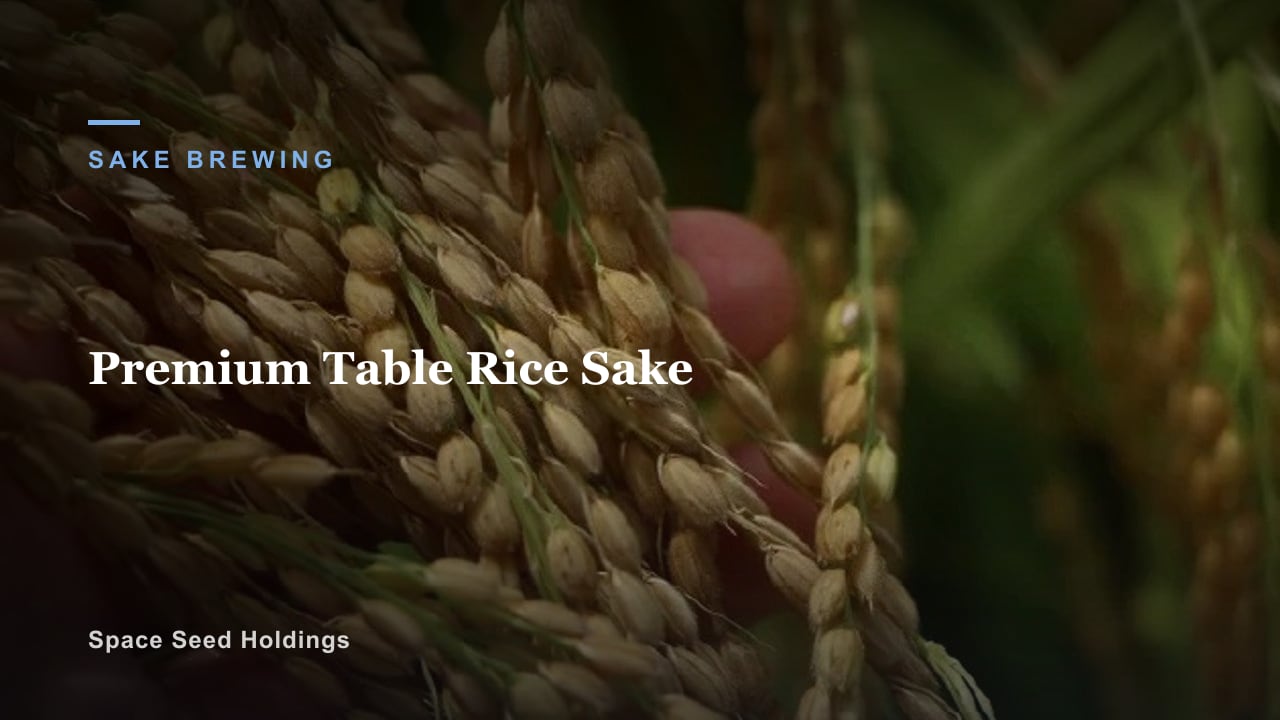
The Premium Table Rice Sake Project rethinks the sake brewing process to create high-value use of edible table rice rather than specialised sake rice, with the aim of revitalising local communities. Tsunan Sake Brewery — led by Kengo Suzuki, who also serves as CEO of Space Seed Holdings — uses 100% Uonuma Koshihikari in the heavy-snow region of Tsunan, Niigata, to craft its flagship “GO GRANDCLASS” and to propose a new global category: “Premium Table Rice Sake.”
Direction
- Defining a table-rice category: Using AI-assisted “Smart Brewing,” Uonuma Koshihikari — a rice meant for the table, not the tank — becomes the flagship raw material for a sake that stands alongside cuisine as an equal.
- Externally validated quality: International competition results, including a Gold Medal at Kura Master 2024 (Junmai Daiginjo category) and a Platinum award at the Milano Sake Challenge 2025, support the quality.
- Local revitalisation and global rollout: Brewing rooted in a heavy-snow terroir contributes to the region, while a multi-layered rollout starting from the US West Coast and Taiwan is under way, with future expansion to markets such as Indonesia and Spain under consideration.
The scientific grounding
Why brewing from table rice is hard
Sake is made through a distinctive method called “multiple parallel fermentation”: the koji mold Aspergillus oryzae breaks down the starch of steamed rice into glucose (saccharification), and within the same mash the sake yeast Saccharomyces cerevisiae simultaneously converts that glucose into alcohol. Running this method stably depends on the koji mold’s hyphae reaching the centre of each rice grain.
Specialised sake rice is bred to have a large central starchy core (shinpaku) that the mold can penetrate, and low levels of the protein and lipids that cause off-flavours. Koshihikari, a table rice, is by contrast bred for eating quality (stickiness, sweetness, umami): its starchy core is small and its protein relatively high, which is why it has generally been considered “difficult to brew with.” That is precisely why making a premium sake from 100% Uonuma Koshihikari is, in itself, the technical heart of this category.
Control through AI-assisted Smart Brewing
Tsunan Sake Brewery operates “Smart Brewing,” which welcomes generative AI as “one of the brewery workers.” Rather than using a general-purpose large language model as is, it structures a three-layer knowledge base — (1) the fundamentals of brewing science, (2) past production logs and component-analysis data, and (3) site-specific context such as “how the brewery’s temperature shifts the day after snowfall” — in a design that curbs the hallucinations that are problematic on a production floor. The AI is not the decision-maker but a “staff officer / second opinion” supporting the master brewer (toji); it is a Human-in-the-Loop operation in which people and AI converse to reach the best answer. As climate change shifts rice quality year by year and past rules of thumb hold less reliably, this supports the work from both the data and tacit-knowledge sides.
A snow-country terroir
Soft water born from the snowmelt of the Naeba mountain range, seeping underground, and the finest table rice nurtured by heavy-snow Uonuma — the interplay of snow, water and rice shapes why table-rice sake makes sense in the land of Tsunan. Heavy snow also serves, in part, as a natural cold store, providing a low-temperature, long-fermentation environment.
Where brewing meets nanobio (still under study; no assertions)
Tsunan Sake Brewery measured the nanoparticles contained in its flagship “GO GRANDCLASS Uonuma Koshihikari Edition” by Nanoparticle Tracking Analysis (NTA), and has published Japanese and English reports on its official site stating that nanoparticles in the same size range as exosomes (30–200 nm in diameter) were detected at high concentration. The reports suggest that nanoparticles derived from yeast and koji mold may be abundantly generated, but evaluating their bioactivity is a task for future research and is not an assertion of health effects. We keep to the measured facts and treat this neutrally as a research area at the intersection of “brewing × nanobiotechnology.”
Recent focus
We are communicating “Premium Table Rice Sake” through tasting and pairing opportunities at premium restaurants on the US West Coast and in the mature Taiwan market. The dedicated site tablericesake.com serves as the multilingual base for establishing the category.